
This page is licensed under Creative Commons under Attribution 4.0 International. Anyone can share content from this page, with attribution and link to College MatchPoint requested.
College Admissions Have Changed. Most Families Have Not.
What 2026 Admissions Results Reveal. And What Smart Families Are Doing Differently.
Written by Lisa Bain Carlton, M. Ed. • Last Updated: March 31, 2026
Key Takeaways
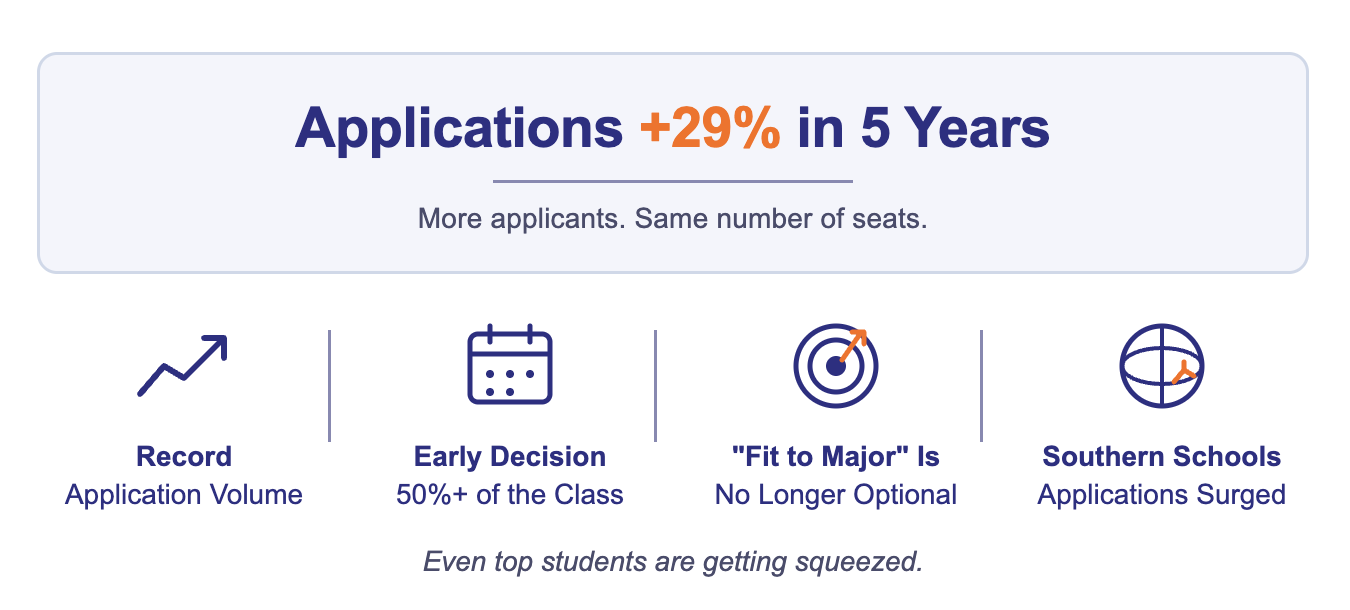
- Admissions is more competitive and more strategic than ever. Applications are up 29%, early decisions now shape outcomes, and even top students are getting squeezed.
- Strategy now matters more than credentials alone. Major choice, early timing, testing, and positioning all play a decisive role.
- Focus on where your student will thrive. Families who prioritize fit, clarity, and a balanced list make better decisions and reduce unnecessary stress.
📈 TAKEAWAY #1
Early Applications Now Define Outcomes
Early is no longer optional for many students. This year, 65% of applicants submitted at least one EA or ED application, with EA up 7% and ED up 2%. Many selective private colleges now fill 45–60% of their class before Regular Decision begins, leaving fewer spots for RD applicants. By March, much of the class is already set.
At Northwestern, more than half the class was filled through Early Decision before January. Brown admitted students at 16.5% in the early round versus 5.35% overall. Yale's EA rate held at 10.1% from the second-largest applicant pool in school history. The early advantage is real, but the pools are more competitive than ever. Applying early without a strategically aligned application can b
At the same time, early pools have become significantly more competitive. Demand growth is driving down early acceptance rates at many schools. Vanderbilt ED dropped from 18% to 12%, Bowdoin ED from 19% to 13%, and Notre Dame REA from 17% to 12%. Emory ED declined from 37% to 25%, and Duke ED fell from 17% to 14%.
Early still provides an advantage, but it is no longer a guarantee. Applying early without a strong, aligned application can backfire.
👉 Learn how to use Early Decision strategically
in
our free webinar.
🕒 TAKEAWAY #2
Even Top Students Are Getting Squeezed
Selectivity at the highest level has not eased. MIT admitted 4.6% of applicants this cycle. Yale came in at roughly 4.24% from nearly 55,000 applications. Columbia accepted 4.23% from its largest applicant pool ever. There has been no easing at the top. Small differences in positioning, alignment, and institutional priorities now carry more weight than the credential stack alone.
Even students with strong grades, rigorous coursework, and impressive activities are seeing unpredictable outcomes. Small differences in positioning, alignment, and institutional priorities now carry more weight than ever. Admissions decisions are no longer purely about credentials.
Families need to adjust expectations and focus on strategy, not assumptions.
👉
Get clarity on where your student stands
and how to improve their positioning.
Register for our upcoming webinars.
📝 TAKEAWAY #3
Testing Is Separating Applicants Again
Testing is once again becoming a meaningful differentiator. Score submission is up 11%, while non-reporting is down 5%. More high-achieving students are submitting scores as selective colleges shift toward test-required or test-preferred policies. Of the top 20 most selective colleges, nine now require SAT or ACT scores.
Penn's Class of 2030 cycle was the first since reinstating its standardized testing policy, a change that may account for a sharp decrease in applications at that school. USC, meanwhile, reported its highest-ever incoming class GPA at 3.92, a signal that the bar for academic achievement continues to rise even at second-tier selective schools.
This creates a subtle but important divide. Students with strong scores can reinforce academic readiness, especially in competitive applicant pools. Students without scores are still viable, but are evaluated differently. As more top applicants submit scores, the advantage of doing so increases.
For many students targeting selective schools, testing is no longer optional in practice.
👉
Understand whether testing strengthens your student's strategy.
Learn more during our May webinars.
💼 TAKEAWAY #4
Major Choice Now Drives Admissions Odds
Admissions is no longer just about getting into a college. It is about getting into a specific academic program. At many universities, competitive majors operate at significantly lower admit rates than the overall school.
At UCLA, Computer Science admit rates are now below 3%, making it one of the most selective programs in the country. Two students applying to the same university can face dramatically different odds based on intended major. Families who overlook this are often surprised by outcomes.
Colleges are increasingly prioritizing students who demonstrate clear academic direction and readiness.
👉 Learn how to align your student’s interests with strategy during
our May webinars.
We have a unique approach at ESM Prep College MatchPoint. It all begins and ends with our ultimate goal: for our students to thrive in their selected college.

To get started, we invite you to schedule a complimentary 30-minute strategy session with our Program Director, Bronwyn Dowling. In this one-on-one conversation, Bronwyn will help you develop a customized plan based on where your student is right now and where they want to go. It's a great first step toward a college journey that feels focused, empowering, and aligned with your student’s goals.
🌞 TAKEAWAY #5
Public and Southern Schools Are Now Highly Selective
Public and Southern universities are operating at levels many families still underestimate. UVA EA is now 12.4% on roughly 57,500 applicants, and many flagship publics have single-digit effective admit rates for competitive majors. Out-of-state applicants often face even lower odds.
More than 82,000 students applied to UVA for the Class of 2030, a 27% increase over the prior year's already record-breaking number. The university extended offers to 4,317 Virginians and 5,970 out-of-state students.
Regional pressure is also increasing competition. Applicants from the Southwest grew 8%, with Texas up 8% and Oklahoma up 13%. This creates tighter conditions for students applying within high-demand regions, especially to public universities.
What once felt like a “match” school is now often a reach.
👉
Reassess your list before it’s too late.
Learn more during
our May webinars.
🌞 TAKEAWAY #6
Athletics Are Accelerating the Application Boom
Athletic success is becoming a powerful driver of application growth at many universities. Schools like Michigan, Notre Dame, and Georgia are attracting more national attention, drawing in larger and more competitive applicant pools. This demand extends well beyond recruited athletes and is reshaping selectivity across the entire institution.
The result is tighter admit rates, especially for out-of-state applicants. Michigan’s overall admit rate is now 17%, with out-of-state closer to 12%, reflecting how quickly these schools have become more competitive. What many families once considered a solid match is now far less predictable.
Brand visibility matters more than ever. Schools rising in prominence are seeing faster increases in demand, which is compressing outcomes across the board.
👉 Don’t underestimate these schools—attend our May webinars to learn how to approach strategically.
🌞 TAKEAWAY #7
Out-of-State Applicants Are Getting Squeezed
Public flagship universities are becoming significantly more selective for out-of-state students. As states prioritize in-state enrollment and manage yield more tightly, fewer seats are available to non-residents. At the same time, demand from high-achieving students across the country continues to rise.
At schools like UVA, Michigan, and UNC-Chapel Hill, out-of-state admit rates are often below 15%, and sometimes lower than comparable private colleges. UVA admits roughly 23% of in-state students but just 12.5% of out-of-state applicants, highlighting the scale of the gap.
These schools should no longer be treated as safeties for non-residents. For many students, they function as highly selective reaches.
👉 Learn the importance of researching residency-based admissions policies and building a smart, balanced college list
during our May webinars.
DOWNLOAD OUR GUIDE TO
Highly Selective Colleges
Applying to a highly selective college can be daunting, but if your student has their heart set on one, there are some guidelines they can follow to help them stand out from the crowd. This guide discusses what highly selective colleges look for in students, how to achieve "depth" in activities, and the importance of having a specific application strategy for the most selective schools.
🌞 TAKEAWAY #8
Institutional Priorities Are Driving Final Decisions
Admissions outcomes are increasingly shaped by institutional priorities rather than credentials alone. Colleges balance academic programs, geographic distribution, socioeconomic diversity, and enrollment targets when building a class. These priorities shift each year and are rarely visible to families.
This helps explain why outcomes feel unpredictable, even for strong applicants. Thousands of students meet the academic bar at selective schools, but only a fraction are admitted based on how well they align with institutional needs. Small differences in positioning can lead to very different results.
Admissions is no longer just about being qualified. It is about being the right fit at the right time.
👉
Understand the importance of tailored applications that show academic alignment, standout involvement, and genuine interest
during our May webinars.
What does this intense competition mean for current high school students aiming high?
Control What You Can
- Dive deeper into activities showing genuine interests and independent drive
- Engage in intellectual pursuits beyond your school curriculum
- Strive for academic rigor and strong test scores if possible
- Research colleges deeply to articulate your fit thoughtfully
Keep Perspective
- Craft a balanced list by considering a wide range of colleges beyond just the most selective schools
- Know that institutional priorities, like an increased commitment to recruiting first-gen students, impact outcomes
- Understand that being "unhooked" makes admissions more challenging
- Remember, not getting into an Ivy doesn't define your potential or worth
Next Steps
By controlling what you can, keeping perspective, and starting early, you can maximize your chances of admission to highly selective colleges. The best thing you can do right now is make this summer count:
- Dive deeper into academic and authentic extracurricular passions
- Engage in self-directed learning and high-impact projects
- Positively impact your community or addressing a national or even global issue
The admissions process is more competitive than ever, but it is also more stressful than most families expect. According to The Princeton Review College Hopes and Worries Survey, 73% of students and parents report high or very high stress during the college application process. At the same time, concerns about cost, outcomes, and uncertainty continue to rise, compounding the pressure families feel. This is not just an admissions challenge. It is an emotional one.
Parents play a critical role in shaping how their student experiences this process. Students do not need a micromanager. They need a calm, steady guide who can provide structure and perspective. Breaking the process into manageable steps, celebrating progress, and protecting time away from college conversations all help reduce anxiety. Small shifts in how families approach the process can have a meaningful impact.
The goal is not just to get through admissions, but to grow through it. When families lead with clarity, empathy, and trust, students are better equipped to handle uncertainty and make thoughtful decisions. In a process that often feels unpredictable, the tone you set at home may be your student’s greatest advantage.
Five simple ways to support your student:
- Break tasks into manageable weekly steps
- Celebrate growth and non-college wins
- Build in screen-free, college-free time
- Ask open questions and listen with empathy
- Model calm responses in moments of uncertainty
You might also be interested in

For some students, food is more than a quick bite between classes—it’s part of the college experience. From iconic local specialties to campus dining programs that emphasize sustainability and creativity, these colleges stand out for offering meals worth remembering. Whether you are drawn to global flavors, farm-to-table dining, or legendary local eats, these campuses give food lovers plenty to savor. Here are 8 colleges for hardcore foodies:

For students dreaming of medical school, the undergraduate experience can be just as important as the MCAT score. Families often assume Ivy League or flagship universities are the only path, but many smaller or lesser-known schools provide outstanding preparation for future doctors. These colleges stand out for their quality advising, research opportunities, access to clinical experiences, and strong medical school acceptance rates. Students at these schools often benefit from smaller class sizes and closer faculty mentorship, making them excellent hidden gems for pre-med success. Here are 10 hidden gem colleges with strong pre-med preparation outside the Ivy League:
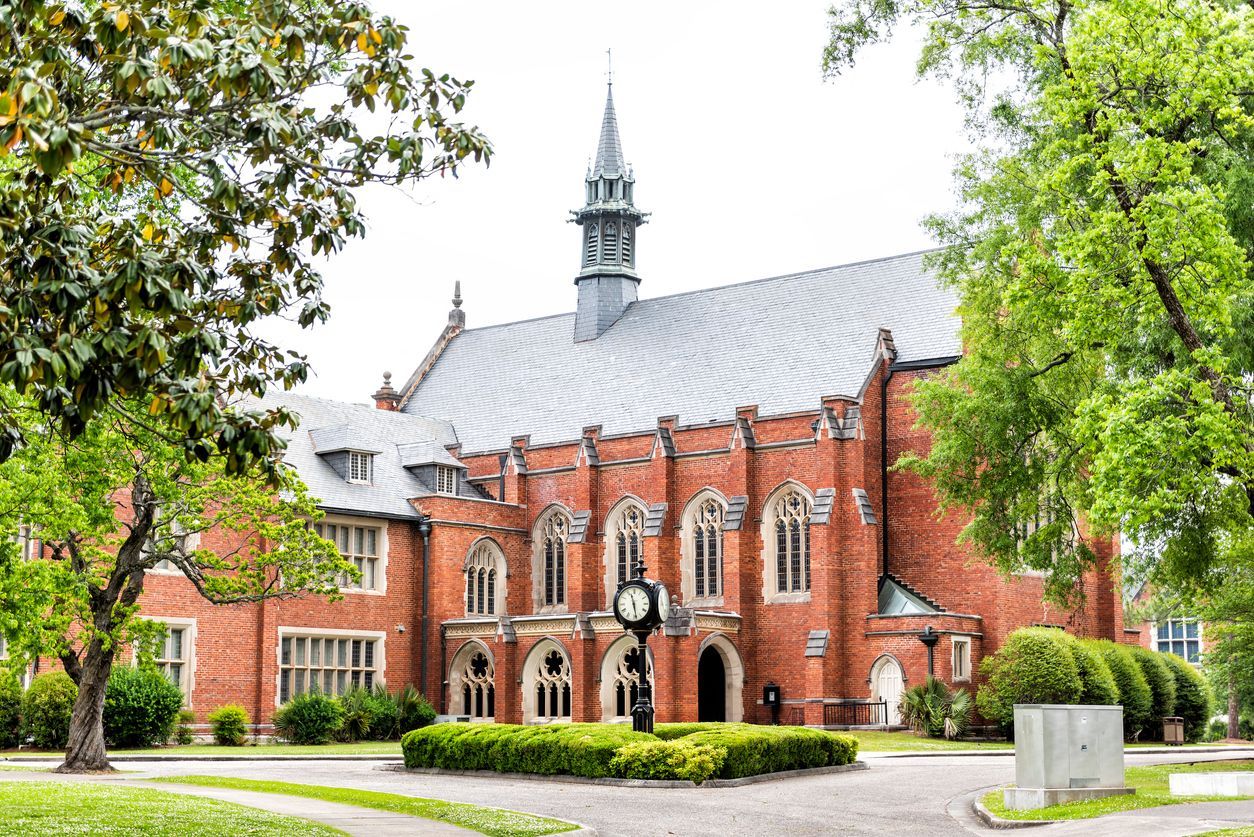
For high-achieving students, an honors college can transform the undergraduate experience. These programs often provide smaller classes, seminar-style learning, faculty mentorship, and special research or travel opportunities. While many families immediately think of highly selective universities when considering honors programs, there are hidden gems across the country that offer exceptional honors education with more accessible admission rates. These schools combine strong academics with an environment where motivated students can thrive. Here are 12 hidden gems with exceptional honors colleges:

Winter break is a rare pause in a busy year. It gives students time to rest, reflect, and reset before the spring semester. Without homework and tests, students can step back and focus on personal growth. These few weeks can help them clarify goals, explore interests, and get organized for what is next.

Summer is more than a pause between school years. It’s an open canvas for students to explore interests, develop new skills, and grow into the people they’re becoming. Whether that looks like volunteering at a local nonprofit, shadowing a professional, or launching a creative project, the summer months offer the freedom to take charge of personal and academic growth. As students move through high school, what they need from summer changes. Freshman year is about curiosity. Sophomore year is about commitment. Junior year is about impact and preparation. Each season builds toward a story that colleges recognize as authentic, purposeful, and uniquely theirs.
High school is about more than grades and test scores. Activities give students the chance to discover new interests, refine skills, and grow into themselves. They also play a major role in how admissions officers evaluate applicants. When colleges review applications, they read activities alongside transcripts, test scores, essays, and recommendations. The goal is not to see who did the most, but to understand who a student is and what they might bring to a campus community. Every student will have a different path, and every activity list will look unique. The key is not to try to “game” the system, but to build a record that reflects genuine interests and growth. Let’s take a closer look at how activities are read in admissions and what families should keep in mind as students shape their high school years.

For students who love the outdoors, sustainability, or agriculture, a college orchard can be much more than a pretty backdrop. Orchards serve as living classrooms, research hubs, and community resources where students study biodiversity, sustainable farming, and food systems in real time. They also connect campuses to their local regions, often donating produce to food banks or selling fruit to support community initiatives. These five U.S. colleges highlight how something as simple as an apple orchard can enrich education and campus life:

For students passionate about global affairs, human rights, and diplomacy, the United Nations can feel like the ultimate classroom. While many schools offer international relations programs, a select few in the United States stand out for their direct connections to the UN. These colleges and universities provide unique access to briefings, internships, and academic programs tied to the UN’s mission, giving undergraduates a front-row seat to international policy in action. Here are 5 U.S. colleges and universities with strong ties to the United Nations:

Public health is a rapidly growing field that blends science, policy, and service to improve community well-being. For high school students drawn to healthcare but not necessarily to clinical medicine, public health programs offer an exciting pathway into careers that focus on prevention, equity, and systemic change. While major universities and schools of public health are well-known, there are hidden gems across the country where undergraduates can gain early research opportunities, strong mentorship, and hands-on community engagement. Here are 10 hidden gem colleges for students interested in public health: