


This page is licensed under Creative Commons under Attribution 4.0 International. Anyone can share content from this page, with attribution and link to College MatchPoint requested.
What Got Students Admitted to UT Austin This Year
Want to help your student stand out in a more competitive process?
100,000+ applications.
The Class of 2026 results made the pattern unmistakable across the students we coached who were admitted to UT Austin. Strong grades and class rank were the baseline, not the differentiator. What mattered most was how clearly a student demonstrated readiness for their first-choice major, within an admissions process that has become far more selective and far more precise than most families realize.
With 100,000+ applications for Fall 2026, early strategic planning is more crucial than ever. Success, especially in competitive majors such as Business, Engineering, and Computer Science, requires a thoughtful approach that begins in 9th or 10th grade. Students should align coursework, activities, and leadership roles with their intended major to build a compelling application.
How Did UT Austin Evaluate Applicants This Year?
UT Austin continues to use a holistic review process, but this year's results made one thing unmistakable:
Academics were the baseline, not the deciding factor.
Most students who were offered admission met high expectations for GPA, class rank, course rigor, and required SAT or ACT scores. Many denied students looked strong on paper, including students in the top 5 percent. What separated admits from denials this year was how clearly a student demonstrated readiness for their first-choice major.
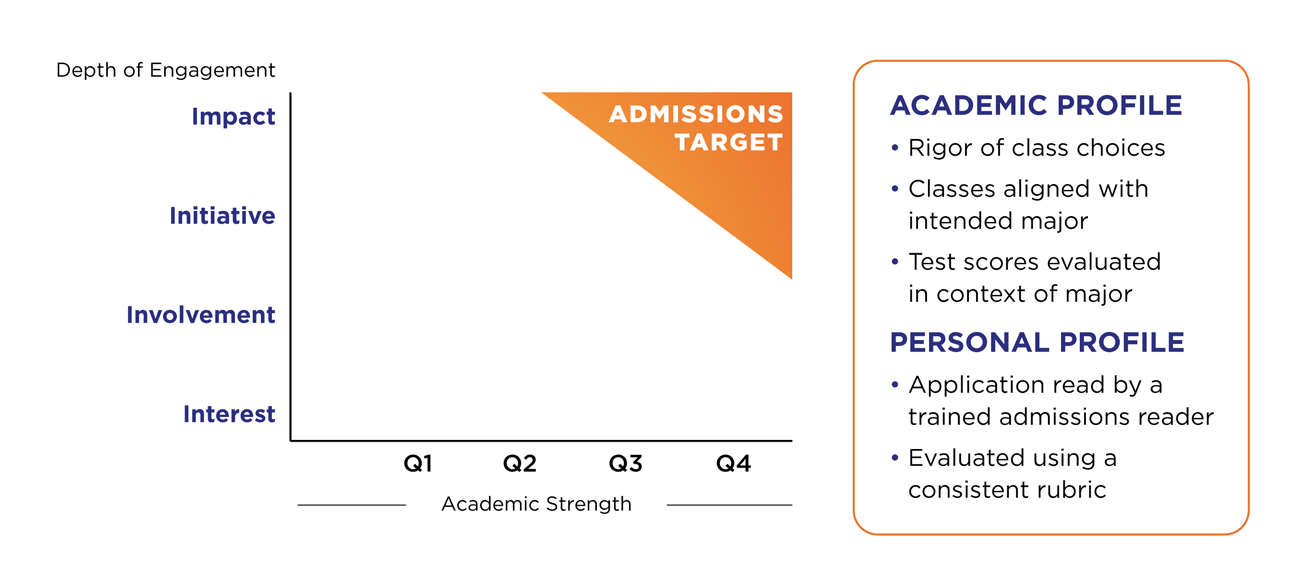
Admissions Decisions Were Made by Major
UT Austin evaluates applicants by major rather than overall profile.
Capacity varies widely across programs, and the first-choice major shaped how every part of the application was read, from transcript to activities to essays. This is why outcomes can feel confusing without understanding how UT allocates seats within each school and department.
Successful Applications Consistently Showed
🎯 Clear Major Alignment
- Coursework that supports the intended academic direction
- Academic preparation that matches the chosen major
🎯 Meaningful Depth
- Three to four experiences tied to the student’s first-choice major
- Activities that demonstrate skill building, curiosity, or exploration
🎯 Growth and Leadership Over Time
- Initiative that develops year over year
- Leadership that reflects responsibility and impact, not just titles
Fit to major was not about checking boxes or choosing an easier path. It was about demonstrating a student's authentic preparation and understanding of the field they had chosen.
UT's Expanded Resume Matters So Much
Grades and test scores show academic readiness. The UT expanded resume shows how a student has actually used their time.
This section of the UT application gives admissions readers a clearer view of:
- How a student pursued interests over time
- The depth and continuity of major aligned experiences
- Leadership, initiative, and follow-through
- Context around opportunities, constraints, and choices
For many applicants, the expanded resume provided the clearest signal of readiness beyond academics. It helped UT distinguish between students with similar grades by revealing intention, growth, and impact over time.
Class of 2026 Results Confirmed:
- Many strong students were competing against nearly identical profiles
- Outcomes feel unpredictable without understanding UT’s priorities
- Depth mattered more than volume
- Direction mattered more than perfection
The students with the strongest outcomes were not flawless. They were intentional. They started earlier, built coherence across their application, and paired strong academics with purpose, direction, and impact.
What Should STUDENTS Focus On?
Academic Excellence: The Foundation of a Strong UT Austin Application
UT Austin’s admissions process is highly competitive, with academics serving as the foundation of a successful application. While strong grades and test scores won’t guarantee admission, they are critical in demonstrating your readiness for college-level work—especially for selective majors.
Competitive Academic Targets
🎯 GPA & Rank: 3.8–4.0 (Unweighted), Top 5% Class Rank
🎯
Target Test Scores: SAT 1400+ or ACT 32+
🎯
Course Rigor: Take AP, IB, or Dual-Creditcourses to strengthen your application.
🎯
Major-Specific Preparation: Enroll in courses that align with your intended major (e.g., Calculus for Engineering and Business).
Understanding the Auto-Admit Policy
✅
Top 5% of Texas public high school students
earn automatic admission to the College of Liberal Arts at UT Austin.
✅
However, admission to selective majors is not guaranteed—a strong application is still required.
How to Build a Winning Transcript
📖
Prioritize Academic Performance:
Take the most rigorous courses you can succeed in.
📝
Set Goals Aligned with Strengths & Interests:
Choose challenging coursework that supports your college and career plans.
🙋♂️
Seek Support When Needed:
Build strong study habits, ask for help from teachers, and collaborate with peers.
💡
Stay Motivated & Disciplined: A strong academic record is key to securing admission and thriving in college.
How to Achieve Competitive Standardized Test Scores
✅
Plan Early: Start preparing for the
SAT/ACT in summer before 11th gradeto allow time for improvement.
✅
Take Rigorous Math & English Courses: Strong performance in
Algebra II, Pre-Calculus, and AP Englishcan boost test readiness.
✅
Use Targeted Test Prep: Take
practice tests, review weak areas, and consider
professional test prep programsif needed.
✅
Retake for a Higher Score: Many students improve scores significantly with
focused prep and a second attempt.
✅
Know Your Target: Aim for
SAT 1400+ or ACT 32+ to be most competitive.
By strategically planning coursework, preparing for standardized tests, and staying engaged in learning, students can build a competitive academic profile that sets them apart in UT Austin’s selective applicant pool.
Major Selection: The Key to Your Extracurricular Plan
When applying to UT Austin, students must select a first-choice major, which plays a key role in how their application is reviewed. The admissions team evaluates each component—transcript, class rank, essays, expanded resume, letters of recommendation, and test scores (if submitted)—through the lens of the chosen major. Their goal is to assess how well an applicant’s academic and extracurricular experiences align with their intended field of study.
While students can list a second-choice major, it is typically not considered for applicants outside the top 5% of their graduating class.
What Makes a Major Competitive?
UT Austin has several impacted majors—programs with more highly competitive applicants than available spots. Gaining admission to these majors requires more than strong academics; applicants must demonstrate a clear fit through coursework, extracurricular involvement, and essays.
UT Austin’s Most Competitive Majors
📌
McCombs School of Business– Unspecified Business
📌
Cockrell School of Engineering– All majors
📌
College of Natural Sciences
– Computer Science and many science majors
📌
School of Nursing– Highly selective due to limited space
📌
School of Architecture – Requires strong academic and portfolio alignment
As competition for these programs increases, students should strategically align their academics, activities, and application materials to showcase their readiness and passion for their chosen major.
Our directory helps you discover summer options that can help give your student an edge at UT
Our team is excited to share our directory of more than 2,000 opportunities, where you can find activities to help your student become more involved in activities that connect with their aptitudes and interests. These resources include listings for courses, programs, research options, and service opportunities available this spring and summer, with options for in-person, online, and hybrid activities.
We will be updating this page frequently over the next several months, adding free programs, fee-based programs, and all types of program delivery options. If you have opportunities you think we should consider adding, please email us atsummer@collegematchpoint.com

Learn More About Admissions at UT Austin

The 2025 admissions cycle revealed something parents and students can no longer afford to overlook: colleges are not just evaluating students. They are building classes that reflect a carefully designed set of institutional priorities. While your teen may have done "everything right," the schools they applied to were also weighing factors well beyond grades and test scores. Understanding these factors is key to helping families navigate the process with less stress and more clarity.

If your teen isn’t in the top 5% of their class, you’ve probably heard some version of this: “There’s no way they’ll get into UT.” It’s a myth we hear all the time—and it’s simply not true. Yes, UT Austin is more competitive than ever. With over 90,000 applicants for the Class of 2025 and an admit rate of just 24% , the numbers tell a clear story. And for students who are not in the top 5% , the odds drop even further: the admit rate for non-auto-admit students was just 11% .

By the spring of sophomore or junior year, many parents feel a quiet panic set in. Conversations with other families get louder. Group chats fill with testing plans and summer programs. Someone mentions a college counselor or a perfect score, and suddenly, it feels like everyone else started earlier and did more. The question parents ask us most often this time of year is simple and heavy. Are we already behind?

Many families believe being in the top 5% makes UT Austin a sure thing. It does not. Auto admit guarantees admission to the university, not to competitive majors like engineering, business, or computer science. Each year, top 5% students are denied their intended major because they misunderstand how UT actually works. See what this year's UT admissions decisions reveal about major-level selectivity.

Many UT Austin denials are not about grades, effort, or intelligence. They are about direction. UT admits by major, not by student. When an application lacks a clear fit to major, even strong students can quietly fall out of contention. Learn how to build a fit-to-major case admissions officers cannot ignore in our UT Results Webinar.

January 15, 2026 Update: UT Austin has released Early Action decisions. This cycle confirms a record 90,000+ applicants and the first year of the reinstated SAT/ACT requirement. Deferred students are still under consideration; final decisions will be released by February 15, 2026.