


This page is licensed under Creative Commons under Attribution 4.0 International. Anyone can share content from this page, with attribution and link to College MatchPoint requested.
UT Austin Admissions Was Clear This Year: What Made the Difference This Year
More than 100,000 students applied to UT Austin this year. Thousands had strong grades. Thousands had impressive test scores. Many were denied. The difference was not perfection. It was alignment. UT is reading every application through one central lens: does this student show clear preparation for their first choice major? Not just interest, but progression. Not just involvement, but initiative and impact. In this cycle, the students who earned a yes built intentional stories over time, with the right courses, the right academic signals, and meaningful summer work that strengthened fit to major. If you are the parent of a teenager who dreams of being a Longhorn, the question is not “Are their grades high enough?” It is “Are they building alignment now?”
Every year, rumors swirl about UT Austin admissions.
“It’s just rank.”
“It’s random.”
“You just need perfect scores.”
The Class of 2026 results tell a very different story.
With more than 100,000 applications submitted this year, UT Austin has firmly moved from public flagship to Ivy level selectivity. In 2006, UT received roughly 20,000 applications. In 2021, that number was 50,000. In 2026, it surpassed 100,000
Demand has exploded. And selectivity has sharpened.
So how did UT actually evaluate applications this year?
Let’s break it down.
From Public Flagship to Ivy-Level Selectivity
UT Austin’s rise is not accidental.
The university has invested heavily in research and academic excellence. Many departments now rank in the top 10 nationally. Highly selective majors such as McCombs, Cockrell, and Computer Science now see non auto admit rates comparable to institutions like Carnegie Mellon and Princeton
.
That shift changes everything.
In this environment, being academically qualified is not enough. Thousands of qualified students were denied this year.
The students admitted were not perfect.
They were aligned
.
The Two Profiles UT Evaluates
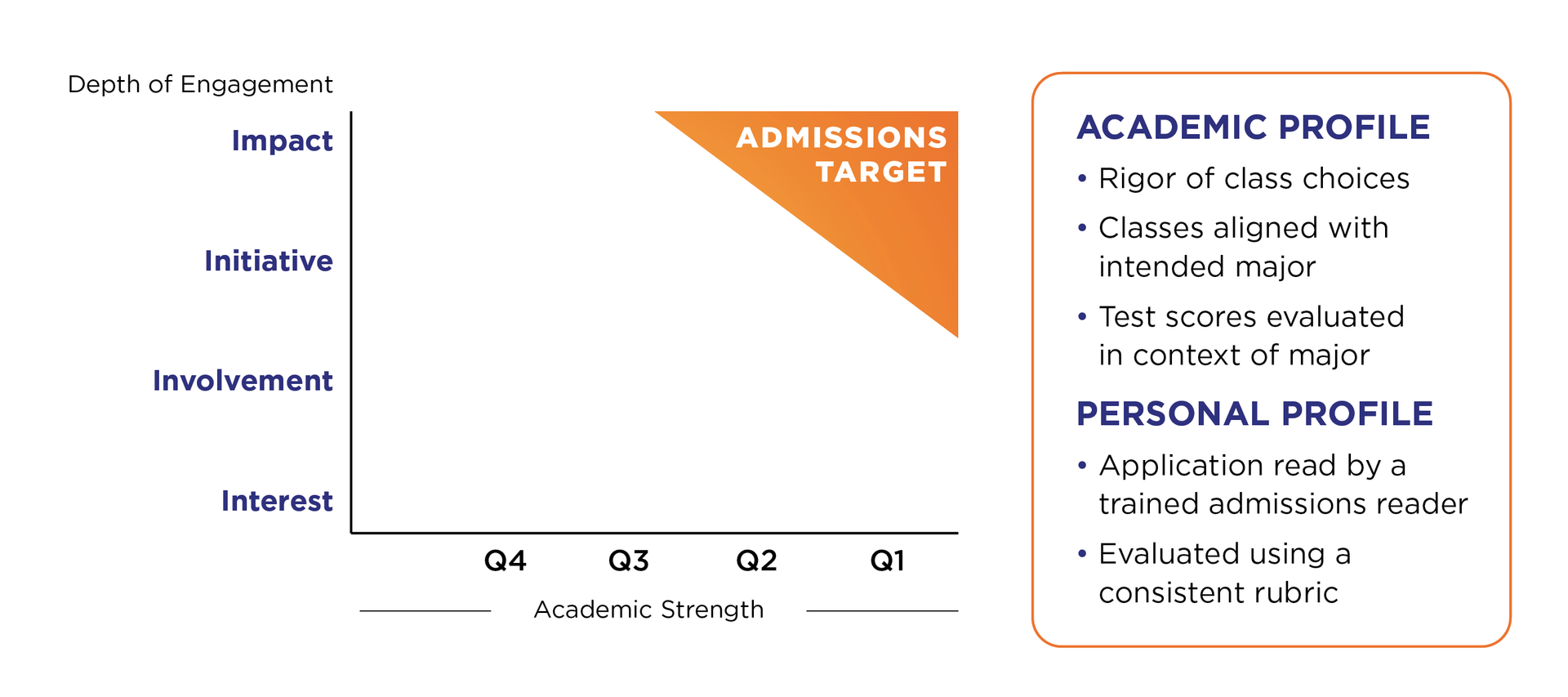
UT’s review process operates across two intersecting profiles:
Academic Profile
Personal Profile
On the academic side, UT evaluates:
- Rigor of class choices
- Classes aligned with intended major
- Test scores evaluated in context of major
On the personal side:
- The application is read by a trained admissions reader
- Evaluated using a consistent rubric
This is holistic review, but it is not vague. It is structured.
Major Strategy: The Foundation of the Application
One of the clearest takeaways this year is simple:
The first-choice major is the foundation of the entire application
.
GPA, test scores, essays, and the expanded resume are all read through that specific lens.
Readers are asking:
- Has this student demonstrated readiness for this major?
- Not interest.
Not curiosity alone. Preparation.
UT is looking for what we call a through line. Evidence of progression over time. Classes, activities, projects, and goals must align.
.
Academic Signals That Made a Difference
With testing reinstated, standardized scores became an important readiness signal again.
Successful holistic admits typically presented scores in the top quartile
.
More specifically:
- Math subscores mattered deeply for STEM and Business
- Successful applicants to McCombs and Cockrell almost universally completed Calculus or beyond by senior year
UT rewarded the right classes over every class. Advanced AP or IB coursework directly supporting the first choice major carried more weight than unrelated rigor
This year reinforced a critical point for families.
It is not about taking every advanced course available.
It is about taking the right advanced courses for your intended major.
Activities Often Made the Difference
If academics established readiness, activities established distinction.Successful admits prioritized depth over breadth. Most had three to four core areas of major aligned engagement rather than a long list of disconnected clubs.
For highly selective majors, this started early.
We also saw a clear shift toward initiative over involvement.
Students who moved from idea to action stood out. Those who launched independent projects, solved problems, or demonstrated leadership without formal titles separated themselves.
UT also valued contribution to the common good.
Quiet leadership counted.
Family caregiving counted.
Translating for parents counted.
Consistent service to faith or local communities counted.
Impact did not have to be flashy. It had to be authentic and aligned.
The Expanded Resume Can Make or Break an Application
UT Austin’s expanded resume remains one of the most strategic components of the application.
Two insights stood out:
- Admitted students showed a clear progression of initiative and impact
- 70 to 80 percent of fit to major activities on successful expanded resumes took place in the summer
Summer was not filler time. It was where alignment deepened.
Many of the strongest applicants used summers to:
- Confirm or refine academic interests
- Launch independent projects
- Complete internships aligned to major
- Build skill based impact
This is not about expensive programs. It is about intentional growth.
If your student hopes to join the next class of Longhorns, the question is not whether they are strong enough. The question is whether they are building alignment, intentionally and early.
Hook ’em.