
This page is licensed under Creative Commons under Attribution 4.0 International. Anyone can share content from this page, with attribution and link to College MatchPoint requested.
Trends From The Early Admissions Results For The Class of 2026
Admissions decisions are rolling in, and while it’s still early in the process, some important trends are already emerging. Application inflation continues to push record-breaking numbers, with many schools reporting unprecedented growth in early application pools. This surge underscores the need for strategic planning, balanced college lists, and early preparation to successfully navigate an increasingly competitive admissions landscape.
While economic inflation may be slowing, application inflation—a trend that began during the COVID-19 pandemic—has firmly established itself as the new normal for the nation’s most selective colleges and majors. According to the Common App, the percentage of students applying to more than 10 colleges has more than doubled, increasing from 8% in 2014 to 17% in 2025. This shift reflects growing concerns about rising competition and declining acceptance rates, as students feel pressured to cast a wider net.
College applications have risen by 4% this year, with over 4 million submissions through the Common App. The Southwestern region grew at nearly twice the rate (10%) of the next fastest-growing region, driven by substantial growth in Texas (9%) and Oklahoma (14%). Mississippi was the fastest-growing state year over year, with 31% growth. Public universities are growing faster than private schools as families focus on affordability, while applications from underrepresented groups, first-generation students, and lower-income ZIP codes steadily rise, thanks to expanded outreach and financial aid.
Growth rates among applicants reporting test scores continue to exceed the rate among those not reporting a score: The number of applicants reporting a test score grew by 11% compared to this time during the 2024-25 application cycle, while the number of applicants who did not report a test score decreased by 4%.
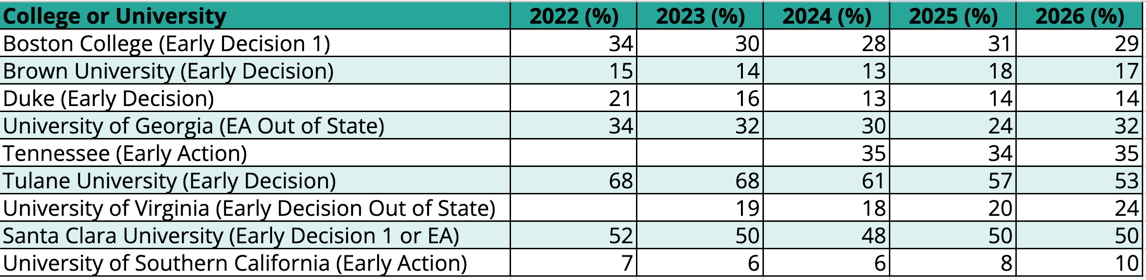
The surge in college applications is transforming the admissions landscape. Nationally, schools like Duke, Rice, and Penn are reporting record-breaking early decision application numbers, pushing acceptance rates to historic lows and making strategic planning more important than ever. This trend underscores the rising popularity of public universities and the increasing competition students face.
What Should Your Student Focus On?
1. Balancing College List-Insurance Against Application Surges
With rising application volume, schools once considered safety options are now as competitive as possible choices. This shift makes a balanced college list more important than ever. A well-rounded list should include a mix of reach, possible, and match schools aligned with your student’s strengths and interests. This approach insulates against application inflation, reduces stress, and ensures students focus on schools where they can thrive academically and personally.
Expanding beyond local schools is also key. Colleges farther from home often provide excellent opportunities for admission and financial aid as they manage capacity challenges. Start by identifying at least two "match" schools where your student’s academic profile exceeds the median GPA and test scores. These schools should offer strong admission odds and align with your family’s financial plan through merit-based scholarships, in-state tuition, or other aid. A solid foundation of match schools ensures realistic options that fit your student’s goals.
2. Showcasing Rigor in Class Choices
In today’s admissions landscape, academic rigor is a key factor in evaluating college readiness. Admissions committees closely examine performance in challenging courses like AP, IB, and Honors classes. Strong grades in these courses demonstrate readiness for demanding material and can help compensate for missing or lower test scores. Highlight your academic rigor throughout your application by showcasing advanced coursework and successes in your activities list, essays, or additional information section.
For students with limited access to advanced coursework, it’s crucial to show how you’ve maximized available opportunities, such as excelling in dual-enrollment classes, independent study, or major projects. Admissions officers value evidence of academic growth and accomplishments like AP exam scores or significant achievements in rigorous courses. Demonstrating your ability to thrive in challenging environments signals readiness for college-level work, making academic rigor essential to a competitive application.
3. Extracurriculars: The Key to Standing Out in Selective Admissions
While test scores and transcripts provide baseline academic metrics, sustained extracurricular involvement can truly set an applicant apart, especially for competitive majors and highly selective schools. Admissions committees value initiative and impact demonstrated through meaningful, multi-year commitments. Whether through school organizations, community engagement, or independent projects, these activities showcase what excites you and how you’ve made a difference. Colleges prioritize quality over quantity, so focus on leadership, growth, and depth of exploration rather than compiling a long list of surface-level activities.
For students targeting selective majors like Engineering, Business, or Pre-Med, extracurriculars are even more critical in demonstrating "fit to major." Activities aligned with your intended field—such as leading a robotics team, launching a nonprofit, or interning in a medical setting—show preparation and dedication to the demands of the program. Use supplemental essays to highlight these long-term commitments and how they’ve shaped your goals. By emphasizing focus, growth, and impact, you signal to admissions officers that you’re passionate and ready to excel in your chosen major.
4. Test-Optional ≠ Test-Ignorant: How to Approach Standardized Testing in College Admissions
With 80% of colleges now test-optional, families might assume SAT and ACT scores no longer matter. However, test-optional doesn’t mean test-irrelevant. Many selective colleges still value strong scores as a measure of academic readiness, and data shows submitting them can boost admissions chances. For example, Boston College admitted 29% of applicants with scores compared to 11% without, and at the University of Virginia, the admit rate was 26% with scores versus 14% without. For students targeting competitive programs or majors, test scores remain a powerful tool for standing out.
Strategic submission is key to maximizing the impact of test scores. Strong scores above a college’s median can validate academic ability, especially for students from schools with less rigorous curriculums. For selective majors like Engineering, Business, or Pre-Med, scores can highlight preparedness and "fit to major." Beyond admissions, many colleges use test scores to award merit scholarships, making a top school more affordable. In today’s competitive and cost-conscious landscape, families should carefully evaluate testing strategies to ensure scores enhance both admission and scholarship opportunities.
We know you have heard that the admissions process is stressful (and it can be).
When you work with ESM Prep College MatchPoint, you’re not just getting a dedicated, nationally-recognized team of college admissions experts—you’re getting a team of people who care about your student and understand the journey your family is on. Our top-notch team works together to make sure your student's entire application stands out from the stack.
Our directory helps you discover summer options that match your student
Our team is excited to share our list of more than 800 opportunities for students to become more involved in activities that connect with their aptitudes and interests. The list includes courses, programs, research options, and service opportunities available this spring and summer, with options for in-person, online, and hybrid activities.
We will be updating this page frequently over the next several months, adding free programs, fee-based programs, and all types of program delivery options. If you have opportunities you think we should consider adding, please email us at
summer@collegematchpoint.com