
This page is licensed under Creative Commons under Attribution 4.0 International. Anyone can share content from this page, with attribution and link to College MatchPoint requested.
AI Didn't Reshape College Admissions This Year. The K-Shaped Divide Did.
If you only followed the headlines, you might think artificial intelligence was the biggest story in college admissions this year.
It wasn't.
The biggest change was the emergence of a K-shaped admissions landscape.
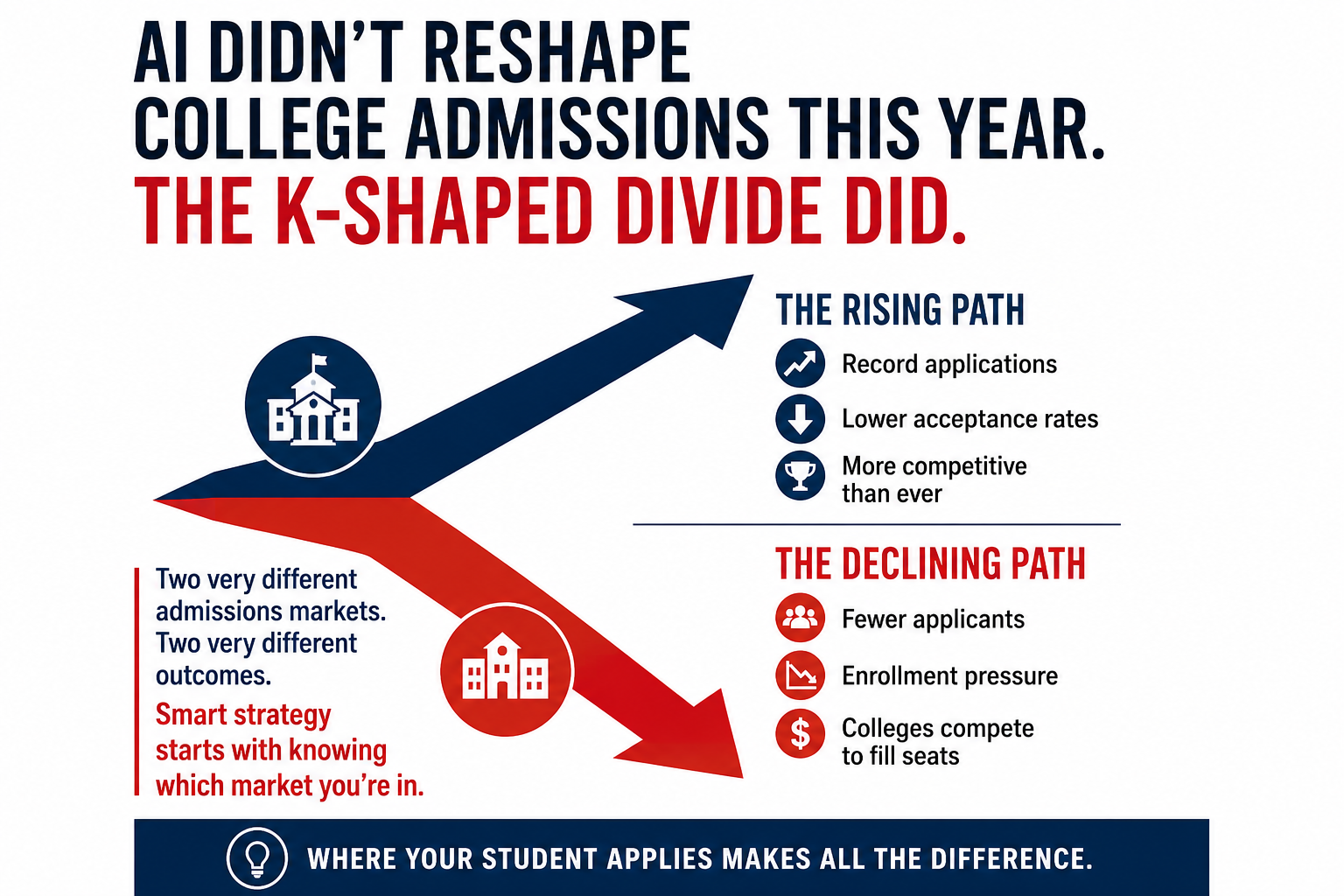
A K-shaped admissions landscape means college admissions are splitting into two very different markets. At one end, the nation's most sought-after colleges and flagship public universities continue to receive record numbers of applications, driving acceptance rates lower each year. At the other end, many colleges are working harder to attract students by increasing merit scholarships, extending deadlines, and expanding enrollment opportunities.
The result is that two students with similar academic profiles can experience completely different admissions cycles depending on where they apply.
Understanding this shift may be more valuable than understanding any new admissions policy or AI tool.
What Is a K-Shaped Admissions Landscape?
Think of today's admissions market as two branches moving in opposite directions.
One branch continues upward. Highly selective universities, flagship public institutions, and nationally recognized programs continue to attract growing numbers of applicants. Admission rates continue to fall while competition for limited seats increases.
The other branch moves in the opposite direction. Many regional universities, smaller private colleges, and less nationally recognized institutions are facing enrollment pressure as the number of high school graduates begins to decline. These colleges are investing more heavily in scholarships, honors programs, and recruitment to build their incoming classes.
This isn't simply about prestige.
It reflects changing demographics, shifting application behavior, renewed emphasis on standardized testing, and the concentration of demand among a relatively small group of colleges.
For families, the takeaway is simple:
There is no longer one college admissions market. There are two.
What This Year's Admissions Results Mean for Students
Academic Rigor Still Matters Most
Selective colleges continued to reward students who challenged themselves academically within the opportunities available at their schools.
The strongest applicants demonstrated:
- Four years of core academic subjects
- Challenging coursework aligned with their intended major
- Strong grades in rigorous classes
For STEM applicants, calculus and physics remained important. For business applicants, calculus and statistics strengthened applications.
What students should do: Build an academic plan with intention. Colleges value rigor in context, not simply the highest number of AP courses.
Standardized Testing Is Back
One of the clearest trends this year was the growing importance of SAT and ACT scores.
Many highly selective colleges have reinstated testing requirements, while strong scores continued to strengthen applications at many test-optional institutions.
Competitive applicants to engineering, business, and other quantitative majors benefited from exceptional math scores.
What students should do: Develop a testing strategy during sophomore or junior year rather than waiting until senior fall.
Colleges Rewarded Alignment
The strongest applications told one consistent story.
Course selection, extracurricular activities, summer experiences, essays, and recommendations all reinforced a student's academic interests.
Admissions officers weren't looking for students who did everything.
They were looking for students who pursued meaningful interests over time.
What students should do: Focus less on building a packed list of disparate activities and more on building genuine expertise and curiosity.
Applying to a Major Matters More Than Ever
Students increasingly compete for admission to individual colleges and majors rather than simply to the university.
Programs in engineering, STEM, business, nursing, and other high-demand fields often admit students at significantly lower rates than the university overall.
Successful applicants demonstrated preparation through coursework, internships, research, independent projects, employment, or sustained extracurricular involvement.
What students should do: Explore academic interests early and build experiences that naturally support your intended major.
Early Applications Still Provide an Advantage
Early Action and Early Decision remained valuable strategies, but many colleges also deferred larger numbers of qualified applicants.
For many students, a deferral reflected increased competition rather than a weak application.
What students should do: Submit your strongest application as early as possible while maintaining a balanced college list.
The Bigger Picture
The question families often ask is whether college admissions has become harder.
A better question is:
Which admissions market is your student entering?
Students applying primarily to highly selective universities will continue to face record competition.
Students with balanced college lists that include institutions where demand is less concentrated may discover generous scholarships, honors programs, and outstanding educational opportunities.
The strategy is no longer simply getting into college.
It is understanding how today's K-shaped admissions landscape affects your student's goals and building a college list that reflects both ambition and opportunity.